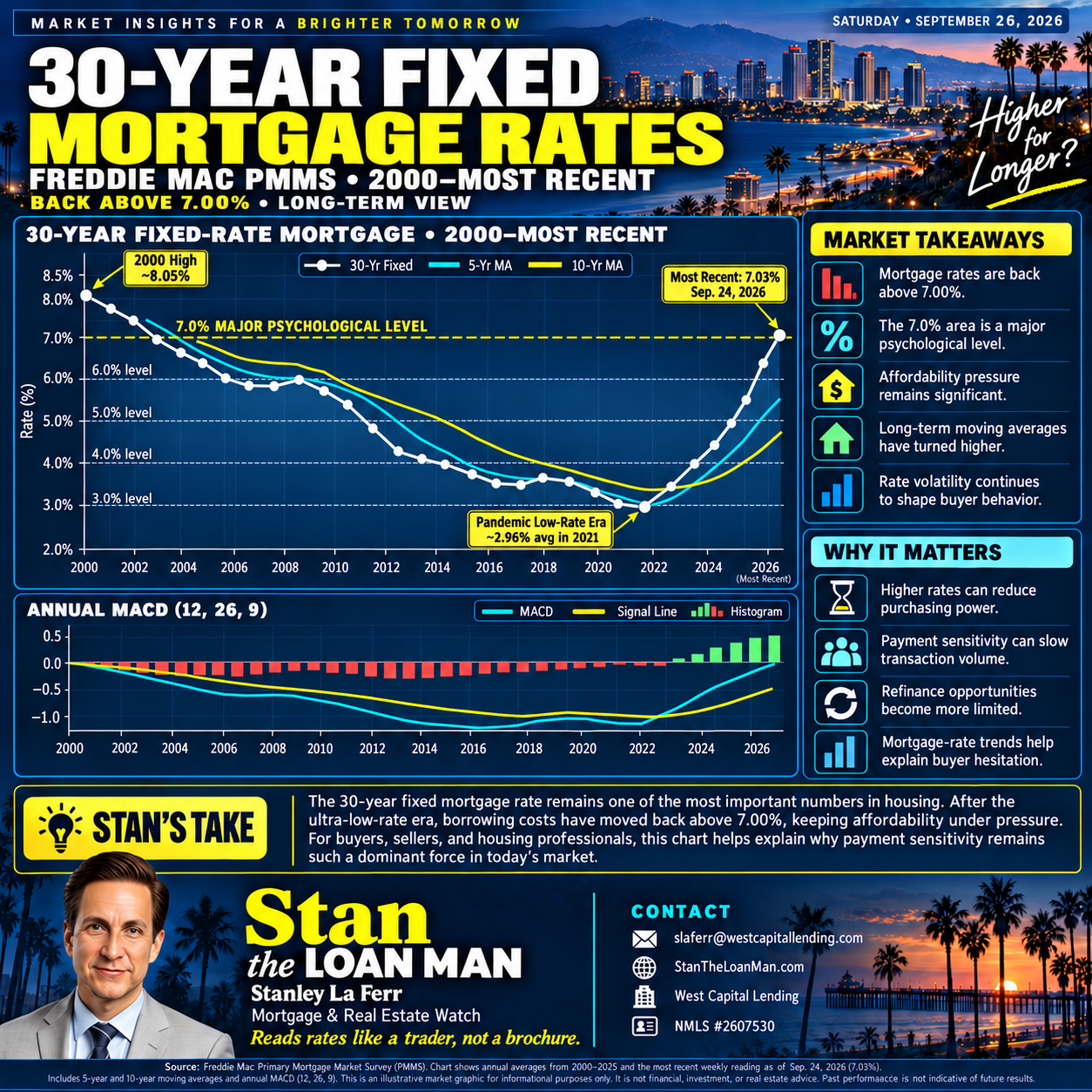
The 30-year fixed mortgage rate remains one of the most important numbers in housing. Freddie Mac’s Primary Mortgage Market Survey moved back above 7.00%, with the September 24, 2026 reading at 7.03%.
From a technical perspective, the long-term chart deserves attention. The 5-year moving average has turned higher, the 10-year moving average is also rising, and MACD momentum has been improving.
A common misconception: “I’ll wait for the next Fed meeting.”
That is one of the comments I hear most often from borrowers. It is understandable, but it oversimplifies how mortgage pricing works.
The Federal Reserve does not directly set the 30-year fixed mortgage rate. The Fed sets a target range for the federal funds rate, an overnight rate. Thirty-year mortgage pricing is influenced by a much broader capital-market process, including Treasury yields and mortgage-backed securities.
Fed decisions matter because they influence expectations for inflation, growth and financial conditions. But the bond market is continuously repricing those expectations — often before a Fed announcement takes place.
What the technical indicators are showing
5-Year Moving Average
The shorter long-term average has rolled higher as the ultra-low-rate years fall further into the rear-view mirror and recent higher-rate years receive more weight.
10-Year Moving Average
The slower moving average has also begun to turn upward. Because it changes gradually, that shift is worth watching as an indication of the longer-term rate regime.
MACD: Momentum
MACD compares exponential moving averages to help visualize changing momentum. On this annual view, momentum has been strengthening from the deeply negative readings associated with the long decline in mortgage rates.
Technical analysis is not a prediction machine. Rates can reverse quickly when economic information changes. But charts help us evaluate what the market has actually been doing rather than relying exclusively on expectations surrounding one meeting or one economic release.
What is influencing mortgage rates qualitatively?
- 10-year Treasury yields: a key benchmark for the longer-duration rate environment.
- Mortgage-backed securities: MBS pricing and spreads directly affect primary mortgage pricing.
- Inflation expectations: persistent inflation can cause investors to demand higher yields.
- Labor-market and growth data: stronger economic data can reinforce higher-for-longer expectations.
- Federal Reserve policy and communication: important for expectations, even though the Fed does not directly set the 30-year fixed.
- Treasury supply and federal borrowing: greater bond supply can affect yields depending on investor demand and maturity mix.
- Global investor demand and risk sentiment: Treasuries and agency MBS compete for global capital.
- Rate volatility: greater volatility can contribute to wider mortgage spreads and less favorable consumer pricing.
Why borrowers should care
At rates above 7%, monthly-payment sensitivity becomes an important part of the housing equation. Higher borrowing costs can affect purchasing power, refinance opportunities, buyer urgency, transaction volume and negotiating behavior.
That does not mean every borrower should wait, lock immediately, or make the same financing decision. The better question is how the current rate environment fits the borrower’s expected holding period, cash-flow goals, available loan structures and potential future refinance strategy.
Look beyond one headline rate.
When rates are elevated, the answer is not always simply to wait. Depending on the borrower, it may be worth comparing fixed rates, ARMs, interest-only options, temporary buydowns such as a 3-2-1 structure, permanent buydowns, lender credits and other program choices. The goal is to evaluate rate, payment, upfront cost, expected holding period and potential refinance strategy together.
It can also be valuable to work with a mortgage professional who can compare a broad range of wholesale lenders and programs for the borrower’s specific qualifications and goals.
Watch the data the bond market is pricing.
Upcoming labor-market, inflation and growth data can move Treasury yields and mortgage-backed securities well before the next Fed decision. The key question is whether new information confirms the current higher-rate momentum or begins to challenge it.
Stan’s Take
The 30-year fixed mortgage rate is not controlled by a single Fed meeting. It is shaped by a broader bond-market framework. Right now, the long-term moving averages are rising, MACD momentum is strengthening, and the move back above 7.00% is meaningful.
Rates will not move in a straight line, and the technical picture can change. But for borrowers and housing professionals, understanding the market’s actual trend is more useful than assuming the next Fed meeting will automatically produce a lower mortgage rate.

Founder, Mortgage & Real Estate Watch · Branch Manager & Mortgage Loan Originator, West Capital Lending · NMLS #2607530. Stan writes about mortgage rates, Treasury markets, housing data and borrower financing strategy.